
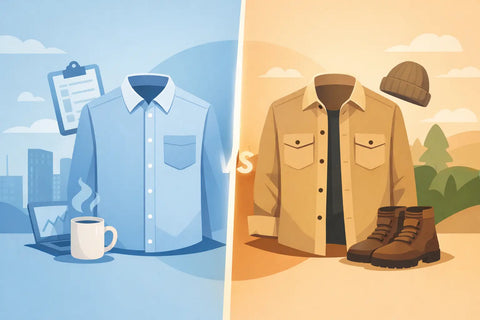
A shirt can be the first layer you put on, the last layer you need, or the piece that holds the entire outfit together. In the work shirt vs overshirt question, the distinction comes down to purpose: one is built to function as a shirt; the other is built to carry the weight of a light jacket.
Both belong to the same workwear lineage. Both can have patch pockets, sturdy buttons, a straight hem, and enough structure to feel considered. But they perform differently once worn day after day. Understanding that difference makes it easier to buy less, choose better, and build a wardrobe with range.
What defines a work shirt?
A work shirt begins with utility close to the body. Historically, it was designed for labor: a hard-wearing layer with enough ease to move, enough pocketing for small tools, and a fabric that could take repeated washing. Its modern role is broader, but the essential logic remains.
It is typically cut to be worn buttoned on its own, tucked or untucked depending on its length and shape. The collar is usually more familiar and shirt-like. The fabric can range from crisp cotton poplin and chambray to denim, twill, herringbone, or brushed flannel. What matters is that it stays comfortable as a base layer.
A good work shirt has substance without becoming cumbersome. It should sit cleanly under a jacket and feel complete when worn alone. Its pockets are useful, but not so oversized that they pull the front out of shape. Its sleeve volume is intentional, not restrictive. These are small construction decisions, yet they determine whether a shirt is reached for weekly or left on the rail.
The work shirt is a daily layer
Think of the work shirt as an alternative to an Oxford, a casual button-down, or a lightweight denim shirt. It can work with utility trousers, tailored pants, faded jeans, or a skirt. In warmer weather, it may be the outermost layer. In colder months, it becomes part of a system beneath knitwear, a worker jacket, or a coat.
Because it sits nearer the body, fit matters. There should be room through the shoulders and chest, particularly in unisex cuts, but not so much that the fabric collapses or bunches under outerwear. A slightly relaxed silhouette gives it longevity. Extreme slimness dates quickly and limits movement.
What makes an overshirt different?
An overshirt is designed for layering first. It occupies the space between a shirt and a jacket: lighter than a chore coat, more structured than a button-down. It should comfortably fit over a T-shirt, jersey long sleeve, knit, or another shirt without looking strained at the armhole or chest.
This requires more volume and, often, more fabric. Overshirts commonly use dense cotton twill, brushed wool blends, heavyweight flannel, canvas, or textured wool. The collar may be broader. The placket may be firmer. Pockets are often larger and placed for access rather than discretion. A straight, jacket-like hem is common because the garment is intended to remain untucked.
An overshirt does not need to be heavy to do its job. Weight is only one measure of usefulness. A medium-weight cotton twill overshirt can be the right layer for a cool office, a flight, or a mild evening. A wool overshirt may replace a jacket through much of fall. The key is that it has enough structure to sit over other layers without losing its line.
The overshirt is a portable outer layer
Its value is versatility. Worn open over a white T-shirt, it gives a simple outfit shape. Buttoned with roomy trousers, it creates a more unified silhouette. Carried over the arm or packed into a bag, it is often more useful than a conventional jacket because it is less formal and easier to integrate with the rest of a wardrobe.
The trade-off is that an overshirt may be too warm or too bulky to wear all day indoors. If you expect to keep it buttoned beneath a blazer or close-fitting coat, the extra pocketing and heavier cloth can work against you. This is where the difference between the two garments becomes practical rather than semantic.
Work shirt vs overshirt: fabric changes the role
Fabric decides how far either piece can travel. A lightweight chambray work shirt can pass through spring, summer, and early fall. It breathes, softens with wear, and layers without friction. But it will not provide much protection when the temperature drops.
A densely woven cotton twill has a different character. It resists wind better, holds a more architectural silhouette, and develops a satisfying surface over time. Used in a work shirt, it creates a substantial daily piece. Used in an overshirt, it becomes a dependable transitional layer.
Denim occupies both categories comfortably. A lighter denim work shirt is a familiar base layer with visible texture and durable appeal. A heavier denim overshirt has more authority, especially with reinforced seams and generous patch pockets. The distinction is not the fiber content alone. It is the relationship between fabric weight, cut, and intended layering.
Pay attention to finish as well. A garment-washed fabric will arrive softer and more relaxed. A rigid or minimally washed fabric will hold shape longer and reveal wear more gradually. Neither is inherently better. Choose softness when immediate comfort matters; choose structure when you want the garment to form around your habits over time.
Fit is about what goes underneath
The simplest way to choose between a work shirt and an overshirt is to consider what you expect to wear beneath it.
If the answer is usually a T-shirt, tank, or nothing but an undershirt, a work shirt is likely enough. It will look cleaner buttoned up, feel less excessive indoors, and layer more easily under jackets. If you regularly wear crewneck knits, hoodies, or thicker jersey layers, an overshirt will give you the required ease.
Do not rely on a label alone. Some garments called overshirts are simply relaxed shirts in heavier fabric. Some work shirts are cut generously enough to function as outer layers. Look at the shoulder width, armhole depth, chest measurement, sleeve circumference, and length. Then consider the cloth. A roomy poplin shirt may still behave like a shirt, while a close-fitting wool twill layer may still feel like a jacket.
For shared or unisex wardrobes, proportion matters even more. An oversized cut can be expressive, but it should remain controlled at the shoulder and sleeve. A piece with a clean collar, balanced pocket placement, and a hem that falls with purpose will work across different bodies more easily than a garment that relies on excess volume alone.
When one garment can do both
The strongest pieces often sit between categories. A midweight twill shirt with a relaxed fit, two chest pockets, and a straight hem can function as a work shirt buttoned on its own, then shift into an overshirt over a tee. This is not a compromise when the proportions are right. It is efficient design.
The same is true of a photographer-style shirt: generous enough for movement, pocketed with intent, and structured enough to hold its form. It can replace a light jacket in transitional weather while remaining usable as an indoor layer. That flexibility is especially valuable in wardrobes built around fewer, better garments.
Still, asking one piece to cover every condition has limits. A shirt that is ideal under a jacket may not be warm enough for a late fall evening. An overshirt that handles cold mornings may feel too heavy in a heated room. A wardrobe system works because its layers have distinct jobs, even when they overlap.
Choose for use, not category
Choose a work shirt when you want an everyday button-front layer that can stand alone, tuck cleanly, and disappear comfortably beneath outerwear. Choose an overshirt when you need more room, more structure, and a jacket-like layer that can be worn open or closed.
If your life moves between studio, commute, dinner, travel, and changing weather, there is a case for both. Start with the one that solves the more immediate problem. Then wear it often enough to learn what is missing.
The right garment should not need constant reconsideration. It should become part of the weekly rotation, acquire its own marks and softness, and make the next layer easier to choose. Details with a past. Forms for now.