
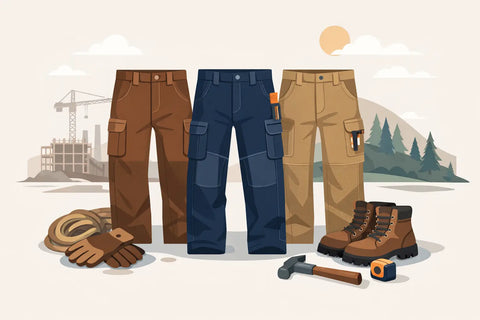
A good pair of trousers reveals itself slowly. The fabric softens at the knee without losing shape. A phone stays put when you sit. The rise works standing, cycling, and reaching for a top shelf. This workwear pants review looks past the first try-on and toward the details that determine whether a pair becomes daily uniform or remains on the hanger.
Workwear has always been judged by use. That standard still holds, even when the trousers are worn to a studio, an office, or dinner rather than a factory floor. The best pairs carry their utility quietly: enough room to move, enough structure to hold a silhouette, and enough material integrity to improve through repetition.
What Makes Workwear Pants Worth Keeping
The category is broad. Painter pants, fatigues, carpenter trousers, utility pants, and balloon pants all borrow from garments designed around labor. Their references are useful, but a heritage label alone does not guarantee a useful garment. The question is whether proportion, cloth, and construction have been considered for the life you actually live.
Start with fabric. Cotton twill remains a strong baseline because its diagonal weave resists abrasion while developing character with wear. Canvas offers more density and a firmer hand, but it can feel restrictive until broken in. Herringbone twill has a textured surface and military lineage, often with a softer drape than canvas. Denim brings familiar durability, though weight, weave, and finishing matter more than the word itself.
There is no universal best weight. A dense cloth makes sense if you commute on foot, carry tools, or want a trouser that holds a clean line through a full day. Lighter cotton is better for warm climates and layered dressing. The trade-off is direct: more substance usually means more structure and a longer break-in; less weight brings ease but may show wear sooner.
A fabric should not need artificial distressing to feel lived-in. Fading, creasing, and small marks are part of the record. Better cloth gives those changes a place to go.
Workwear Pants Review: The Fit Test
Fit is where many otherwise well-made workwear pants fail. A straight leg can read clean on one body and constrained on another. A wide leg may feel architectural and balanced, or simply oversized, depending on the rise, hip allowance, and shoe worn beneath it. Measurements matter, but movement matters more.
Try the full range before deciding. Sit down. Take a long stride. Bend at the knee. Put your hands in every pocket. If the seat pulls, the rise is likely too short or the cut too narrow through the upper thigh. If the waistband collapses or rotates, the waist may be too large even if it feels comfortable when standing still.
The rise deserves particular attention. A higher rise often gives workwear pants their stable, grounded feeling. It allows the trousers to sit at the natural waist or just below it, leaving more room through the seat and making a shorter jacket or tucked shirt feel intentional. Mid-rise cuts can be easier to wear casually, especially with longer shirts. Neither is inherently better. The right choice depends on your torso, preferred proportions, and how you build an outfit.
For unisex trousers, avoid treating the size label as a verdict. Start with the garment measurements, then decide where you want the waistband to sit. The same pair may be worn fitted at the waist by one person and lower, with more volume through the leg, by another. One garment. Different bodies. Different lives.
Length is not an afterthought. A full break gives a relaxed, utilitarian effect but can gather dirt and wear at the hem. A slight break is more controlled. Cropped or ankle-length cuts show the footwear and work well with wider silhouettes, though they can feel less adaptable across seasons. If the hem is generous, alteration is simple. Adding length is not.
Construction You Can See and Feel
Workwear construction should serve stress points, not perform toughness for its own sake. Look closely at the inseam, rise seam, pocket corners, belt loops, and closure. These are the areas that take repeated tension.
FelIed seams and flat-felled inseams enclose raw edges, reducing friction and creating a clean interior. Triple-needle stitching can add strength where it is needed, especially across major seams, though more stitching is not automatically better. Dense, even stitches with no loose threads are a more reliable sign of care than decorative reinforcement applied everywhere.
Bar tacks at pocket openings, a properly secured fly, and firmly attached belt loops matter because they prevent the small failures that make a garment feel disposable. Pocket bags should be substantial enough to carry keys, a wallet, or a phone without twisting or pulling through. On carpenter or utility styles, external pockets need to lie flat when empty. A feature that flaps, bulges, or catches is not utility. It is noise.
Hardware should feel proportionate to the cloth. Heavy metal buttons on lightweight cotton can distort the front of the trouser. A zip should run smoothly without warping the fly. Buttons, hooks, and drawcords are all valid choices when they match the intended use and silhouette.
Pockets Are a Design Decision
More pockets do not make better pants. They change the line of the garment, add weight, and affect how it moves. Consider what you carry and where you want that weight to sit.
Deep front pockets are useful, but openings that are too vertical can let objects slide out when seated. Rear patch pockets offer a clear workwear reference and distribute bulk well, while welt pockets create a flatter, more tailored finish. Tool loops and side utility pockets are practical for some days and unnecessary for others. Their value depends on your routine, not the photograph.
A restrained pocket layout usually makes trousers more versatile. It can move from a worktable to a restaurant without feeling costumed. That flexibility is central to a lasting wardrobe: function retained, context expanded.
How Workwear Pants Should Age
The first month tells you about comfort. The first year tells you about quality. Well-made trousers should become more specific to you without becoming fragile. Expect creases at the hip and knee, softening at the waistband, and gradual tonal variation at exposed edges. These are not defects.
What should not happen quickly is loss of shape at the seat, torn pocket bags, spiraling side seams, or a waistband that stretches beyond recovery. Some shrinkage is normal with untreated or minimally processed cotton, so care instructions and fabric composition deserve attention before washing. If the fit is exact on day one, consider whether the cloth is likely to relax or contract.
Wash less often than instinct suggests, especially for denim and heavier twill. Brush off dry dirt, air the trousers between wears, and spot clean when possible. When laundering is needed, turn them inside out, use cold water, and avoid aggressive drying. Heat is hard on cotton fibers, color, and shrinkage control. Care is not ceremony. It is part of keeping a good garment in service.
The Better Measure of Value
Price is easiest to compare at checkout and least useful over time. A lower-priced pair that loses its shape after a season is not economical. An expensive pair with a narrow, difficult fit may be beautifully made but still wrong for your wardrobe. Value comes from repeat wear.
Consider cost in relation to frequency, repairability, and range. Can you wear the trousers with a sweatshirt, an oxford shirt, a work jacket, and a knit? Can the hem be repaired? Is the fabric substantial enough for regular use but appropriate for your climate? A pair that answers yes to those questions has a place in a considered rotation.
At WORKWARE, the strongest workwear trousers are not designed as costume or nostalgia. They are forms for now: generous where movement asks for space, structured where shape matters, and made to gather a history of their own.
Choose the pair you will reach for on an ordinary Tuesday. That is where construction proves itself, fabric earns its patina, and a useful garment begins to feel irreplaceable.