
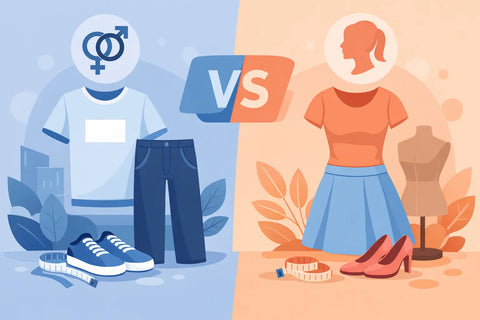
A worker jacket should not ask who it is for before it tells you how it fits. The real question in unisex sizing vs womens sizing is not which category is better. It is how a garment was patterned, where it carries ease, and whether its proportions work with your body and the way you move.
Sizing labels can suggest certainty. They rarely provide it. A size medium may describe a chest measurement, a set of production standards, or an intended silhouette. It does not describe every shoulder, waist, hip, or preferred way of wearing a garment.
Unisex sizing vs womens sizing starts with the pattern
Women's sizing is usually developed from a block shaped around a relatively narrower shoulder, a more defined waist, and fuller hip allowance. Sleeve lengths, rises, and garment lengths are often adjusted accordingly. That does not mean every women's garment is fitted, or that every wearer wants that shape. It simply describes the starting geometry behind the pattern.
Unisex sizing generally begins with a straighter, more neutral block. It often allows more room through the torso and shoulder, less waist suppression, and a longer body or sleeve. In workwear, that directness is intentional. A chore coat needs room for a shirt beneath it. A utility trouser needs enough ease to sit, walk, and carry what the day requires.
But unisex does not mean shapeless. Good unisex design is specific about proportion: shoulder placement, collar scale, armhole depth, pocket position, rise, and leg volume. A balloon pant can be generous without looking oversized. A photographer shirt can sit cleanly through the neck and chest while retaining useful room across the back.
The distinction matters because a size label cannot replace a garment's measurements. A women's medium and a unisex medium may share one measurement, such as chest width, while fitting entirely differently through the shoulder, hip, sleeve, or length.
What changes when you move between size systems
The most visible difference is often ease. Ease is the space between your body and the garment. Some is necessary for motion. Some creates a particular silhouette. A fitted women's shirt may have limited ease at the chest and waist; a unisex work shirt may hold more volume through the body, so it can layer over a tee or light knit without pulling at the back.
Length is the second major shift. Unisex tops are often longer in the body and sleeve. On a shorter frame, this can create a relaxed, coat-like proportion. On a taller frame, it may feel balanced. Neither outcome is wrong. It depends on whether you want the hem to sit at the hip, cover more of the seat, or layer beneath outerwear.
Trousers require a closer read. Women's pants often account for more hip-to-waist difference and may use a shorter rise. Unisex trousers commonly have a straighter waist-to-hip line, a roomier seat, and a longer inseam. If your hips are proportionally fuller than the garment's waist, you may need to choose a size that clears the hip and then use a belt, adjust the waistband, or select a cut with intended volume.
This is why converting a women's size directly to a unisex letter size is only a starting point. It can point you toward a range, but it cannot predict the finished fit.
Measure the garment you already trust
The most reliable reference is not a generic conversion chart. It is a garment you wear often and understand well. Lay it flat without stretching it, then compare its measurements with the dimensions provided for the piece you are considering.
For tops and jackets, focus on chest width, shoulder width, sleeve length, and body length. For pants, compare waist, front rise, hip width, thigh, inseam, and leg opening. These measurements explain more than a label ever can.
When measuring yourself, take the body measurement at the fullest or most relevant point, then allow for the fit you want. A close-fitting tee needs less space than a worker jacket. A pair of utility trousers intended for daily movement should not fit like tailored wool pants.
Four measurements deserve particular attention:
- Shoulder width affects how a jacket hangs and where the sleeve begins. A dropped shoulder is designed to sit beyond the natural shoulder point.
- Chest or pit-to-pit width determines whether a top can layer comfortably. Double a flat chest measurement to compare it with the full garment circumference.
- Rise changes how trousers sit on the body. A higher rise can create room through the seat while visually lengthening the leg.
- Inseam and finished length determine whether the garment stacks, crops, cuffs, or falls cleanly over footwear.
Choose for the silhouette, not the category
A person who usually shops women's sizing may prefer a smaller unisex size in a roomy shirt, then take their usual equivalent in a fitted base layer. Someone who usually shops men's or unisex sizing may choose a women's trouser for its higher waist and shaped hip. There is no contradiction in this. Categories describe construction, not permission.
Start with the garment's intended line. A classic worker jacket should have enough room to close over a layer, but it should not pull across the upper back when you reach forward. A straight-leg utility trouser should have enough seat and thigh room to move, while the waistband remains secure enough to keep the rise where it was designed to sit.
Sizing up is useful when you want more layering capacity, a lower shoulder line, or a longer, more relaxed shape. It can be less useful when the increased size makes the neck opening too wide, the shoulder too long, or the rise too deep. Those details are difficult to solve after the fact.
Sizing down can produce a cleaner, closer fit, especially in shirts cut with generous ease. Yet it may restrict movement at the shoulder or hip before it looks visibly tight. Try the motions that matter: reach for a shelf, sit down, bend to tie a shoe, place your hands in your pockets. Workwear should make room for a life in motion.
Fit notes are part of the design
Words such as relaxed, boxy, straight, cropped, oversized, high-rise, and wide-leg are not decorative. They are fit information. Read them alongside the measurements.
A boxy shirt is broad relative to its length. A relaxed jacket may have additional chest and armhole ease. A wide-leg pant can still fit neatly at the waist. Cropped does not always mean short, particularly on a shorter torso or when worn high at the waist.
If a garment is described as unisex, look for the details that define its form rather than assuming it is simply a men's garment offered to everyone. At WORKWARE, unisex design is considered as a shared structure: one garment, different bodies, different lives. The goal is not to erase proportion. It is to make proportion useful.
Give the garment time, but not too much
Natural fabrics settle after the first wears and washes. Denim softens at the points of movement. Cotton canvas becomes less rigid. A shirt can become more personal through use. Still, do not rely on wear to correct a fundamentally wrong size.
A jacket that is slightly firm through the chest may break in. One that prevents you from crossing your arms is too small. Pants with a crisp waist may give modestly over time. Pants that pinch at the hip or slide down because the waist is too large need a different size or a different cut.
The best choice is the one that works before it becomes familiar. Begin with measurements, respect the intended silhouette, and leave enough room for the way you actually live. Clothes built to stay should earn their place from the first wear.