
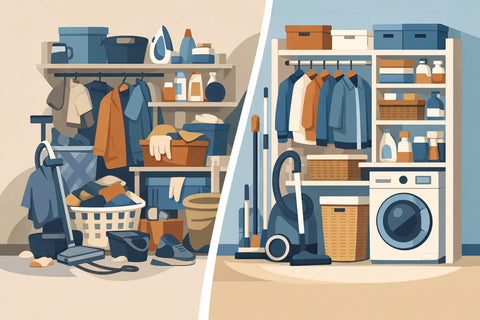
The difference in a utility wardrobe before and after is rarely dramatic in the way trend content likes to show it. No costume change. No personality reset. The real shift is quieter. You stop getting dressed around isolated pieces and start dressing from a system.
That system matters because utility is not an aesthetic add-on. It is a way of choosing garments - by fabric, cut, purpose, and repeat wear. Before, a wardrobe often looks full but underperforming. After, it looks more focused, but it works harder.
What a utility wardrobe before and after really shows
Most wardrobes built by accumulation share the same problem: too many single-purpose clothes, too many near-duplicates, and not enough pieces that can absorb daily use. You might have trousers that look good standing still but lose shape by noon, outerwear that works for one temperature band only, or shirts that layer poorly because the proportions were never considered.
A utility wardrobe corrects that by treating clothing as infrastructure. The garments do not need to be identical or overly severe. They need to cooperate. A worker jacket should sit cleanly over a shirt and under a heavier coat. A utility trouser should allow movement, hold its line, and work with more than one shoe. A denim shirt should function open, closed, and layered. Before and after is not about owning less for its own sake. It is about owning with intention.
There is also a visual shift. Before, the wardrobe can feel busy even when the palette is restrained. After, the same person often appears more defined. Not because utility wear is louder, but because repetition creates clarity. Certain silhouettes return. Certain fabrics age together. The wardrobe begins to read as a point of view.
Before: full rails, weak rotation
The "before" stage is usually not a lack of style. It is a lack of consistency in use. Many experienced buyers know this feeling well. You have good pieces, but they do not form reliable combinations. One jacket wants slim trousers. Another only works with one knit. A shirt looks right untucked but bunches under outerwear. You end up wearing 20 percent of the wardrobe 80 percent of the time.
This is where utility clothing earns its place. It closes the gap between appreciation and actual wear. A well-cut fatigue pant, a sturdy overshirt, a chore coat with enough room through the arm, a durable cotton tee with real body - these pieces do not ask for special handling. They invite repetition.
The trade-off is real. A utility wardrobe may feel less expressive if your current closet relies on novelty for energy. If you enjoy frequent visual change, reducing the range can feel restrictive at first. But for most people, that feeling fades once the daily friction disappears. Ease has its own appeal.
Fabric is often the deciding factor here. Before, garments may look finished on the hanger yet fail in wear because the cloth is too thin, too limp, or too precious. After, the wardrobe tends to lean into materials with structure - dense cotton twill, rinsed denim, oxford, canvas, ripstop, brushed moleskin, wool with enough weight to hold shape. These fabrics improve with use. They remember the body without collapsing into it.
After: fewer variables, stronger silhouettes
A strong utility wardrobe after the shift is not sterile. It has character, but the character comes from cut, wear, and consistency rather than decoration.
You start seeing the same logic repeated across categories. Pants have room where movement needs room. Jackets are proportioned for layering, not just appearance. Pockets are useful without becoming costume. Closures are simple. Hardware is chosen for durability. Hems, rises, cuff shapes, collar stands - small construction decisions begin to matter more than surface styling.
This is where seasoned dressers usually find the value. Once the base is right, getting dressed becomes faster without feeling generic. A balloon trouser changes the line without losing practicality. A photographer shirt can read crisp or relaxed depending on the layer above it. A worker jacket gains authority through wear rather than trend context.
The result is not sameness. It is range inside a disciplined frame.
How the transformation happens
A utility wardrobe rarely arrives through a single purge. It is built by replacing friction points with better answers.
Start with what fails in real life. Not what photographs badly. Not what feels theoretically wrong. What do you avoid reaching for on a normal week? Which garments need too much weather coordination, too much ironing, too much mood? Which ones cannot take repeat wear?
Then look at your actual anchors. Most people already have them. The trouser that always works. The jacket that improves every outfit beneath it. The shirt with the right balance of structure and ease. These are not random favorites. They reveal your functional preferences - rise, width, sleeve volume, fabric weight, pocket placement, hem length. Build from those facts.
This is also the moment to be honest about silhouette. Utility wear is often misunderstood as universally boxy or oversized. It is not. Some bodies and lifestyles want generous volume. Others need a cleaner line. The point is not to imitate a workwear archetype too literally. The point is to choose garments that let the body move and the wardrobe layer.
A good "after" wardrobe usually tightens in three areas at once: color, material, and purpose. The palette becomes easier to combine - ecru, navy, olive, black, faded indigo, tobacco, steel gray. Fabrics start speaking to each other. Uses become clearer. One light outer layer. One heavier one. Trousers for daily rotation. Shirting that works alone and under jackets. Knitwear or sweats with enough structure to hold the same line.
The pieces that do the most work
Not every wardrobe needs the same exact garments, but certain categories consistently carry the load.
Utility trousers are often the first real change. When the rise is right and the leg has enough intention, they replace multiple compromised pants at once. They can handle walking, sitting, commuting, and long wear without becoming sloppy. That makes them more useful than a trouser that looks sharp for an hour and then gives up.
A worker jacket or chore coat is another hinge piece. It gives shape to whatever sits under it and takes stress well. Worn over a tee, it is direct. Over a shirt, it is cleaner. Under a coat, it still reads as part of the system. That versatility is what separates utility from styling.
Shirting matters more than many people expect. An oversized shirt in the wrong fabric can be dead weight. The right one becomes year-round infrastructure. Open over a tank or tee, buttoned under outerwear, half-tucked with fuller pants, worn repeatedly without losing form - this is where utility wardrobes become seasonless.
Denim, too, changes when viewed through use rather than category. The question is less "Do I need jeans?" and more "What denim earns rotation?" Often the answer is not the stiffest or the most washed. It is the pair that breaks in honestly and sits well with your other garments.
Utility wardrobe before and after by lifestyle
The strongest version depends on how you live.
If you dress for a studio, creative office, or mixed day that moves between desk work and errands, utility can be almost complete. You want garments that shift context easily. Structured overshirts, fuller trousers, washed shirting, clean knitwear, and outerwear with some architecture usually cover most situations.
If your work environment is more formal, the change may be partial. A full utility wardrobe might not fit every weekday, but utility principles still improve the closet. Better fabric, calmer color, stronger outerwear, shoes that age well, and weekend pieces that share the same visual language all make the wardrobe more coherent.
If climate is a factor, adjust the material, not the philosophy. In warmer regions, utility relies more on breathable cotton poplin, lighter twill, herringbone, and washed linen blends. In colder places, it leans into wool overshirts, heavier canvas, and dense jersey. The point is durability and repeat use, not heaviness for its own sake.
What people often get wrong
The most common mistake is overcommitting to the image of utility instead of the function. Too many cargo details, too much hardware, too much historical reference - and suddenly the wardrobe feels like a costume. Real utility is usually calmer than people expect.
Another mistake is buying all at once. The best utility wardrobes have a worn-in logic. They are refined over time. You notice which hem length works with your shoes, which jacket length balances your trousers, which cotton weight survives your week. That information cannot be rushed.
There is also the question of fit across bodies. One garment. Different bodies. Different lives. A utility wardrobe works best when it allows personal proportion rather than enforcing one rigid ideal. Sleeve roll, pant break, waistband position, and layering depth all change the result. The system should adapt to the wearer, not the other way around.
What changes in the end is simple. You trust more of what you own. Your best pieces stop waiting for the right occasion and start handling ordinary days. The wardrobe becomes quieter, more exact, and more lived in. Buy better. Keep forever. Then let the wear tell the story.